
The Acquisition of Bun.js Signals a Shift in Programming Paradigms
/ 5 min read /
Table of Contents 目录

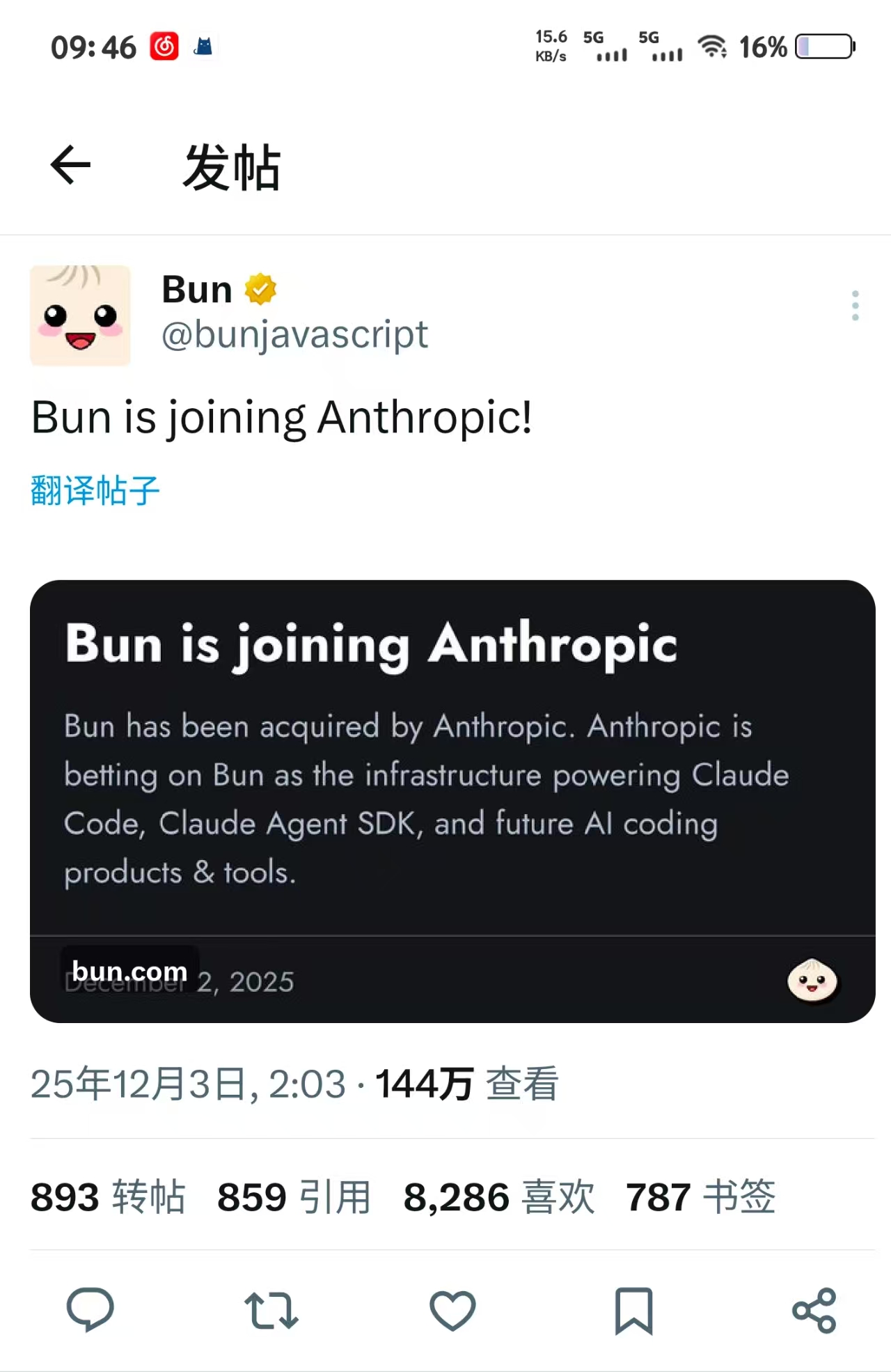
Over the past few months, I’ve been tinkering with small projects using Bun.js. The experience has been great—fast, lightweight, and simple. But when I woke up this morning and saw the headline “Bun acquired by Company A (Anthropic),” I was pretty surprised.
But after reading a few in-depth reports and putting two key facts together—
- Claude Code’s annualized revenue has already exceeded $1 billion
- Claude Code’s runtime itself is built on top of Bun
—everything suddenly made sense: this isn’t just buying a runtime tool; it’s a major infrastructure acquisition for the era of AI-driven programming. I realized: this means we’re entering a new programming paradigm.
Here are the four parts I’ll share:
- A brief intro to Claude Code and the problems it currently faces
- What exactly is Bun.js, and why is it worth acquiring?
- The changes brought by Bun.js + Claude Code
- How I personally plan to navigate this “new programming paradigm”
Claude Code: Every Programmer’s Go-To, and Its Current Problems
Claude Code (henceforth: CC) is undoubtedly one of the most popular AI programming agents right now, especially in the TUI (Terminal User Interface) space. Before we dive in, let’s look at the evolution of AI programming:
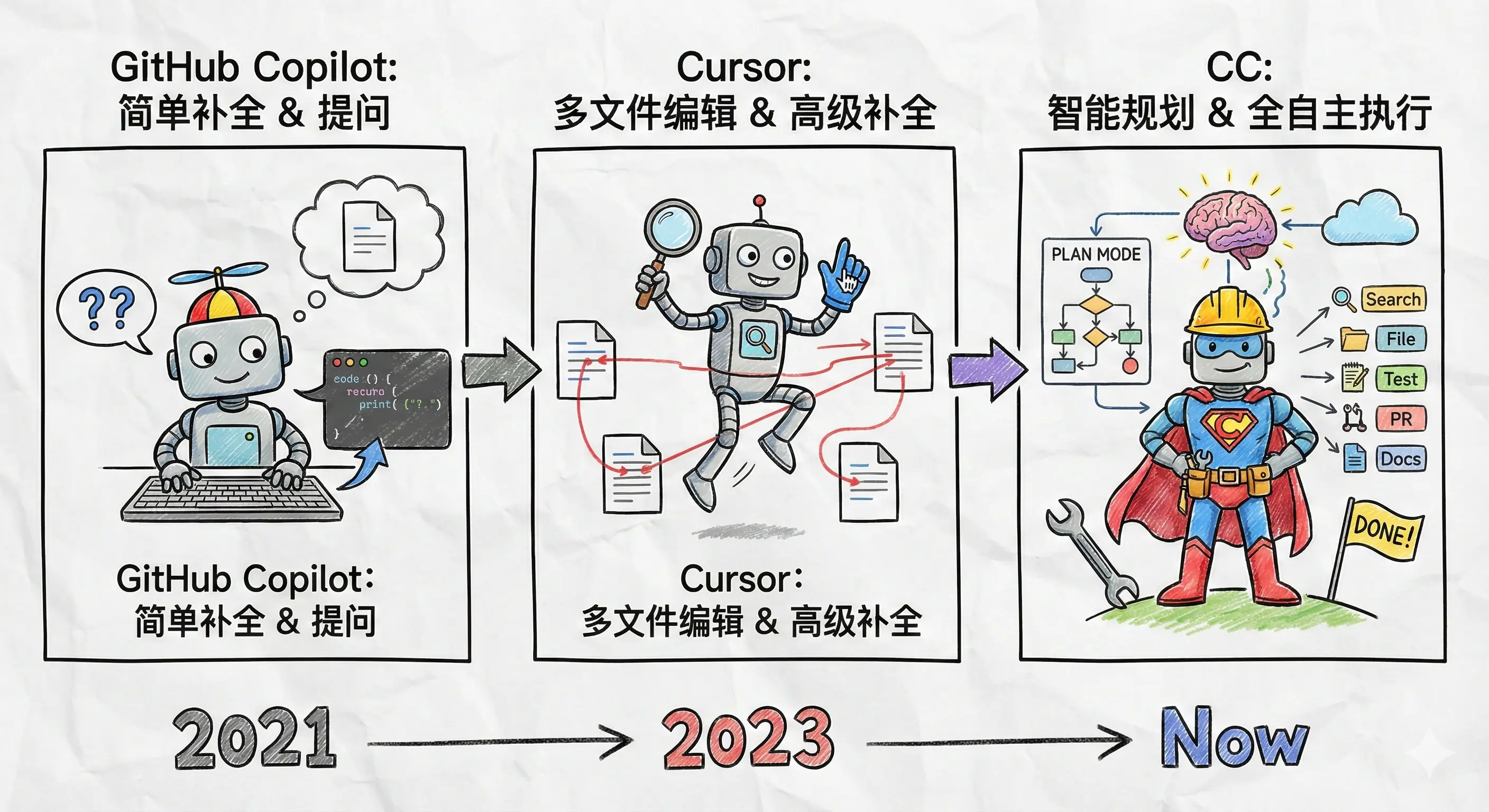
It started with GitHub Copilot, which was mostly simple code completion and pop-up question-answering.
Then came Cursor, which could modify and confirm changes across multiple files at once, offer multi-file auto-completion, and so on.
Now we have CC, which can receive a requirement, automatically search the web, scan local files, create a plan (Plan Mode), execute that plan step by step—each step calling native tools to help fulfill the requirement—and afterward automatically run linters, run tests to verify results, and finally summarize the task. It can even directly submit a PR for you or write documentation.
You can see that AI is getting more and more efficient. We (programmers) have shifted from writing code manually to:
- Defining requirements
- Designing architecture and systems
- Verifying AI outputs
In other words, we rely entirely on AI to produce code, then step in when necessary to fix what AI can’t solve.
If you’ve used CC, you’ve probably been amazed by its power: you write a simple prompt, and it automatically analyzes your requirement and implements it, just like a real engineer. But sometimes you might also grumble:
- Why is it so slow?
- Why does it talk nonsense with such confidence?
- Why does it consume tokens so fast?
- If you’re an early user, you might also complain: why can’t I use it in the terminal on Windows?
That’s just my perspective as an ordinary user. As a CC developer, you probably face even more issues. If there were a tool that could solve one or two of these problems, how could Anthropic not be tempted? That tool is Bun.js.
What is Bun.js, and Why Did Anthropic Take a Liking to It?
At first, my impression of Bun.js was just “a faster Node.js.” After looking into it more carefully, I realized Bun’s ambitions go far beyond that. It aims to be an all-in-one toolbox—packing all the tools needed for modern JavaScript development into a single binary.
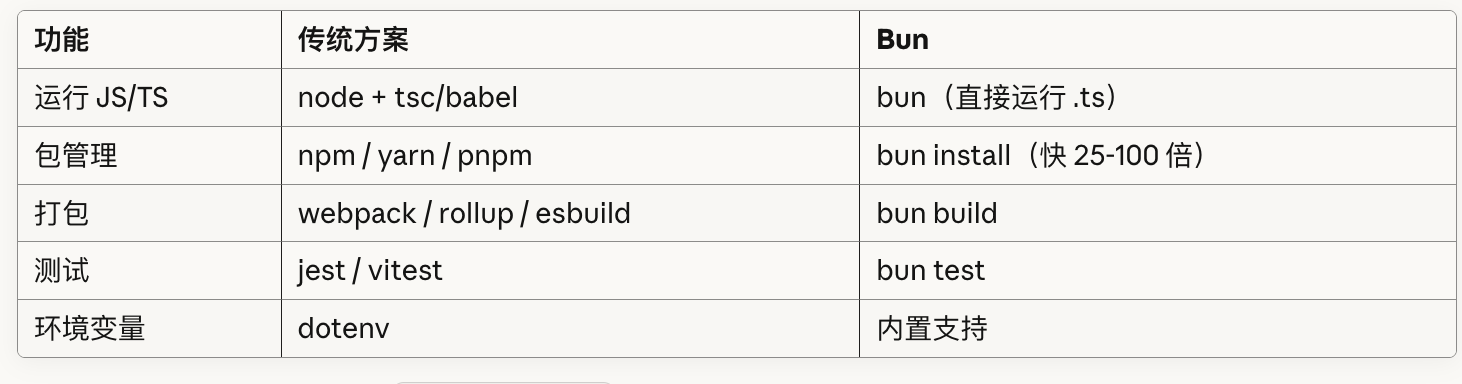
From the diagram, you can see there are many choices in the frontend toolchain, and they often have version compatibility issues. But Bun bundles them all in! No more worrying about compatibility between different tools. This kind of solid, stable happiness is exactly what an AI coding agent needs.
Most importantly, Bun is very fast. Under the hood it’s written in Zig (a modern systems programming language that gives precise memory control and avoids the random pauses of garbage collection). It also uses JavaScriptCore instead of V8 to improve cold start speed and memory consumption.
Earlier we mentioned that CC initially couldn’t be used from the command line on Windows, but later it could. The implementation principle is based on Bun.js’s powerful bundling capability: it packages your application, all dependencies, and even the Bun runtime itself into a single standalone executable binary.
Bun supports “single-file executable,” which is also valuable for AI coding agents. The AI can use the Bun environment to verify that its code is correct.
Bun.js + CC = ?
Now that Bun has been acquired by Anthropic, it’s safe to say CC will become faster and faster. Its ability to solve problems will greatly improve, and Bun itself will get better too. When we create new projects, we can choose Bun as an option, not just Node.js. At the same time, AI programming is entering a new paradigm: AI shifts from being a Copilot (assistant) to becoming an Owner (the dominant role in programming). The manual labor of writing code that programmers used to do will be replaced by AI.
How to Prepare
I think AI-assisted programming is going through three stages:
Stage 1: Generation AI generates code snippets, humans copy-paste, run, debug. Everyone did this when ChatGPT first came out. People found copy-pasting annoying, so we moved to the next stage.
Stage 2: Orchestration AI is embedded into the workflow via IDE plugins (Copilot) or tool calls. It sees context and gives more accurate suggestions. But essentially it’s still “assistance.”
Stage 3: Autonomous (Agentic) AI agents independently complete the full loop: write → run → test → fix. The human role changes from “writing code” to “describing requirements” and “reviewing results.”
Claude Code is pushing us into Stage 3. Bun’s addition accelerates that. My strategy is:
- Shift your mindset from being a code writer to being a system builder.
AI can write code, but it still can’t understand business requirements. We need to translate the product manager’s requirements into prompts that CC can understand, then verify its implementation and ensure code quality.
- Become someone who understands the business and the system.
AI can easily write high-quality code, so no matter how well we write code manually, we’ll be outdone by those using AI coding tools. So understanding your current business deeply and being able to design good system architecture becomes even more important.
- Keep learning, embrace change.
The only constant is change. Embrace it.