
Some thoughts on RoboTaxi
/ 5 min read /
Table of Contents 目录
Hello everyone, I’m A Xing. Let me start by sharing a true story. Last Thursday evening at 8 PM, I finished work and was planning to head home. Just as I stepped out of the office, there was suddenly a violent storm. Luckily I ran fast and took shelter under a building. But the rain showed no sign of stopping—in fact, it kept getting heavier. I thought about getting a cab! I tried for a long time but couldn’t find one. Eventually, I managed to get an extremely expensive ride, and the driver’s attitude was terrible. He said the pickup location I set was wrong (I was on the opposite side), and I had to admit fault before he agreed to come get me. At that time, I didn’t know Wuhan already had Luobo Kuaipao. Thinking about it, if Luobo Kuaipao had been available, wouldn’t it mean that for someone like me, office workers wouldn’t have to worry about not getting a ride when it rains? I believe many people working in big cities have had similar experiences. Sometimes you also get a driver whose car smells awful—it’s really unpleasant. So when I saw Luobo Kuaipao, my eyes really lit up.
The Birth of Luobo
Based on what I’ve found online, “Luobo Kuaipao” is a self-driving taxi service launched by Baidu, aiming to provide the public with a convenient and safe travel experience through advanced autonomous driving technology. The service relies on Baidu’s Apollo (https://www.apollo.auto/apollo-self-driving) autonomous driving platform, integrating multiple sensors such as LiDAR, cameras, and millimeter-wave radar, combined with deep learning and data fusion algorithms to achieve high-precision perception and intelligent decision-making of the surrounding environment. Baidu started working on autonomous driving as early as 2013. In 2017, they launched Apollo, the world’s first open autonomous driving platform. Baidu, with its ambition to become the world’s largest autonomous driving service provider, has pinned all its “family hopes” on Luobo Kuaipao. By 2024, that’s 11 years—Baidu can’t afford to lose anymore. It desperately needs Luobo Kuaipao to re-establish itself as a top-tier internet company. Besides Baidu, the country is also promoting “new quality productive forces.” I think this is the best explanation for it: Luobo Kuaipao is the first wave of domestic AI comprehensive technology disrupting traditional industries. There will be more “new quality productive forces” to come. In fact, Luobo’s real competitor isn’t those ride-hailing drivers—it’s Tesla. The technology used by Luobo Kuaipao is vehicle-road coordination. What does that mean? It means data interoperability between the vehicle and the road, using the data from both to determine the vehicle’s actions. But Musk doesn’t think that way. He believes that since human drivers can drive, it proves that road data isn’t needed; by simply simulating the information human drivers perceive, intelligent driving can be achieved. So Tesla uses single-vehicle intelligence technology, i.e., FSD (Full Self Driving). I can only say that Musk is really badass. If his technology is realized, truly intelligent driving can be achieved anywhere, whereas Luobo Kuaipao cannot, because in places without road monitoring—where road data is unavailable—vehicle-road coordination won’t work. So if Tesla achieves single-vehicle intelligence, it would be terrifying. Imagine driving to work, then at the company, the Tesla goes off to run Didi rides until it’s time to head back—even science fiction wouldn’t write it like that. At that point, Tesla’s stock would definitely skyrocket.
Different Voices About Luobo
It’s been several days since this whole Luobo Kuaipao thing. Regarding it, some people hope it will be fully rolled out quickly (like me), and others hope it comes slowly (countless drivers). The most direct voices come from the financial market. Luobo Kuaipao’s arrival has also boosted Baidu’s stock price quite a bit, indicating that many people are optimistic about its future prospects. Let’s take a look at some voices on Weibo.

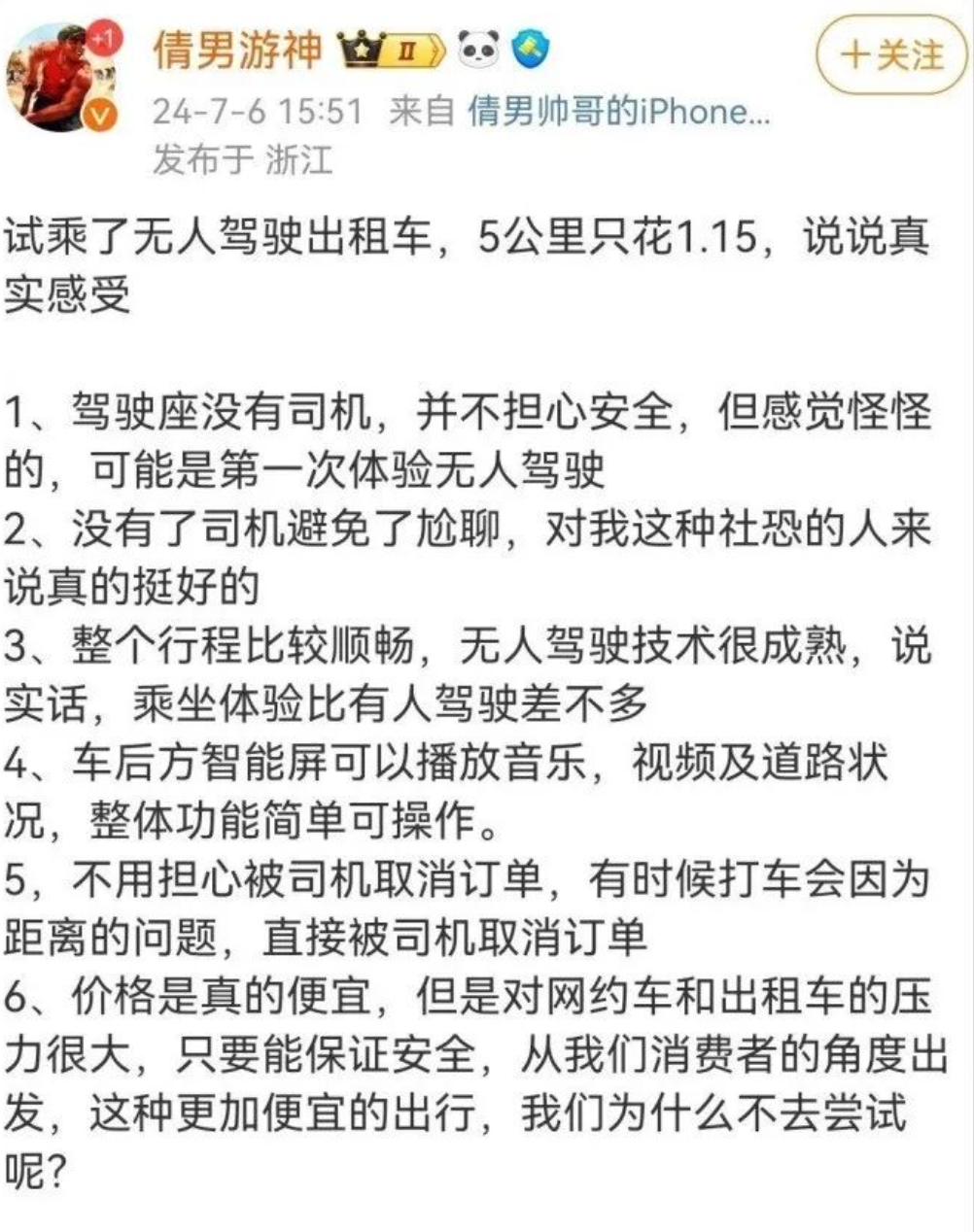
Basically: Some say Luobo is going to take away drivers’ livelihoods. In the future, delivery workers and couriers will also lose their jobs. Others say Luobo Kuaipao is really convenient and saves money.
Dreaming Big About Luobo
- Every year I go home by train or other means. If Luobo is really that good, could I ride a Luobo home someday?
- Whenever I go from Hangzhou to Shanghai, I always end up grabbing a ticket for a train that leaves after 10 PM (when the subway closes), or take a very late flight. If Luobo existed, I wouldn’t have to worry about not being able to get a ride, or ending up with a shady driver.
- A few years ago, many women were victims in taxi incidents. Would having Luobo mean we no longer need to worry?
- If Luobo’s self-driving cars really become widespread, could freelancers in the future work, live, and travel in their cars?
As a Programmer, How to Face the AI Impact
Finally, the impact of AI hit programmers first. Over the past couple of years, layoffs in the internet industry have been non-stop, and often large-scale. Many companies publicly state that AI has completed the work of the laid-off employees. What used to be a day’s work for an ordinary programmer can now be done in half a day with the help of AI. So when facing AI and any new productivity force, we need to try, accept, and experience it—only then can we remain competitive in the workplace.
Thanks for reading. Feel free to leave your thoughts ✌️