
Developed a product earning $12k/month in just four days with AI.
/ 9 min read /
Table of Contents 目录
Translation of a great article: https://www.indiehackers.com/post/tech/building-a-product-with-ai-in-four-days-and-hitting-12k-in-four-weeks-HxoUuTymcPNvhCNe8b6A
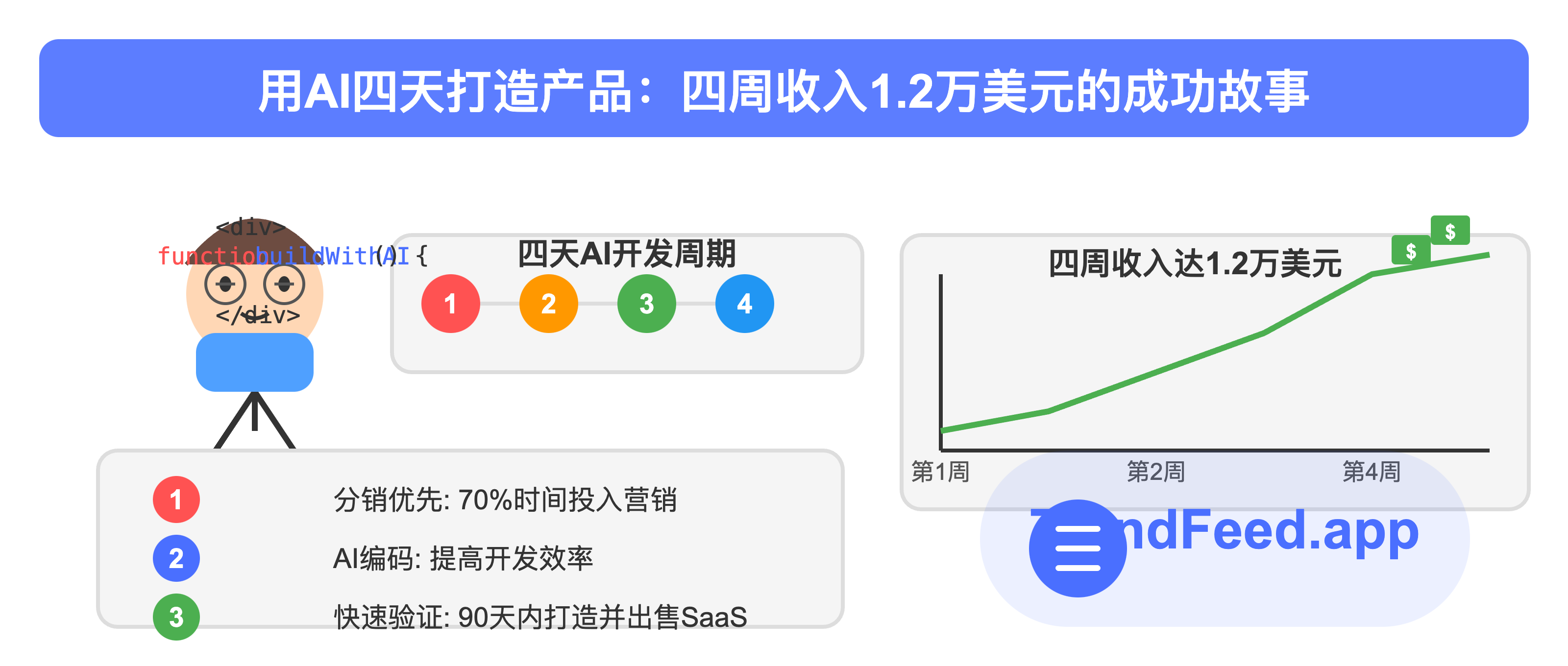
Sebastian Volkers built a product with AI in four days. Four weeks later, TrendFeed hit $12,000 in revenue. And his AI coding course CodeSpring has generated $45,000 since January.
Here are Sebastian’s success tips. 👇
Contents
- Using AI to quickly turn an idea into a minimal MVP product
- Multiple ways to promote and validate commercial viability
- Set goals and future plans
Getting Started
Since I can remember, I’ve been involved in all sorts of business ventures. First selling digital products, then running a YouTube channel making photography tutorials, then dropshipping.
After graduating (I studied Physics and Astrophysics), I started working as a freelance media buyer. But I hated it, so I quit and was unemployed for six months, during which I tried to learn how to build applications.
I stumbled upon various AI coding tools and no-code platforms like Bubble, and built my first app ChatIQ.ai. In the first two months, I hit around £7,500 ($9,700) in monthly recurring revenue (MRR).
The biggest challenge was that I couldn’t build features as fast as competitors. As a complete non-technical beginner, I quickly started losing users to alternatives.
To catch up, I started using GPT-4 to write Python APIs and build feature extensions that integrated with my Bubble app. It worked, but it was slow and full of bugs. Eventually I realized I needed to build with full-stack code, but I didn’t want to spend months learning programming from scratch.
Learning to Build Products with AI
Based on my ChatIQ experience, I figured I could use AI to code. So I practiced by building several micro SaaS products, learning how to develop apps with AI and Next.js. Now I’m able to guide AI to write secure and efficient code and deploy it to production.
During this learning process, my twin brother Matthew suggested: “Let’s team up — you handle product development, I’ll handle marketing.”
Goal: build and sell a SaaS product within 90 days.
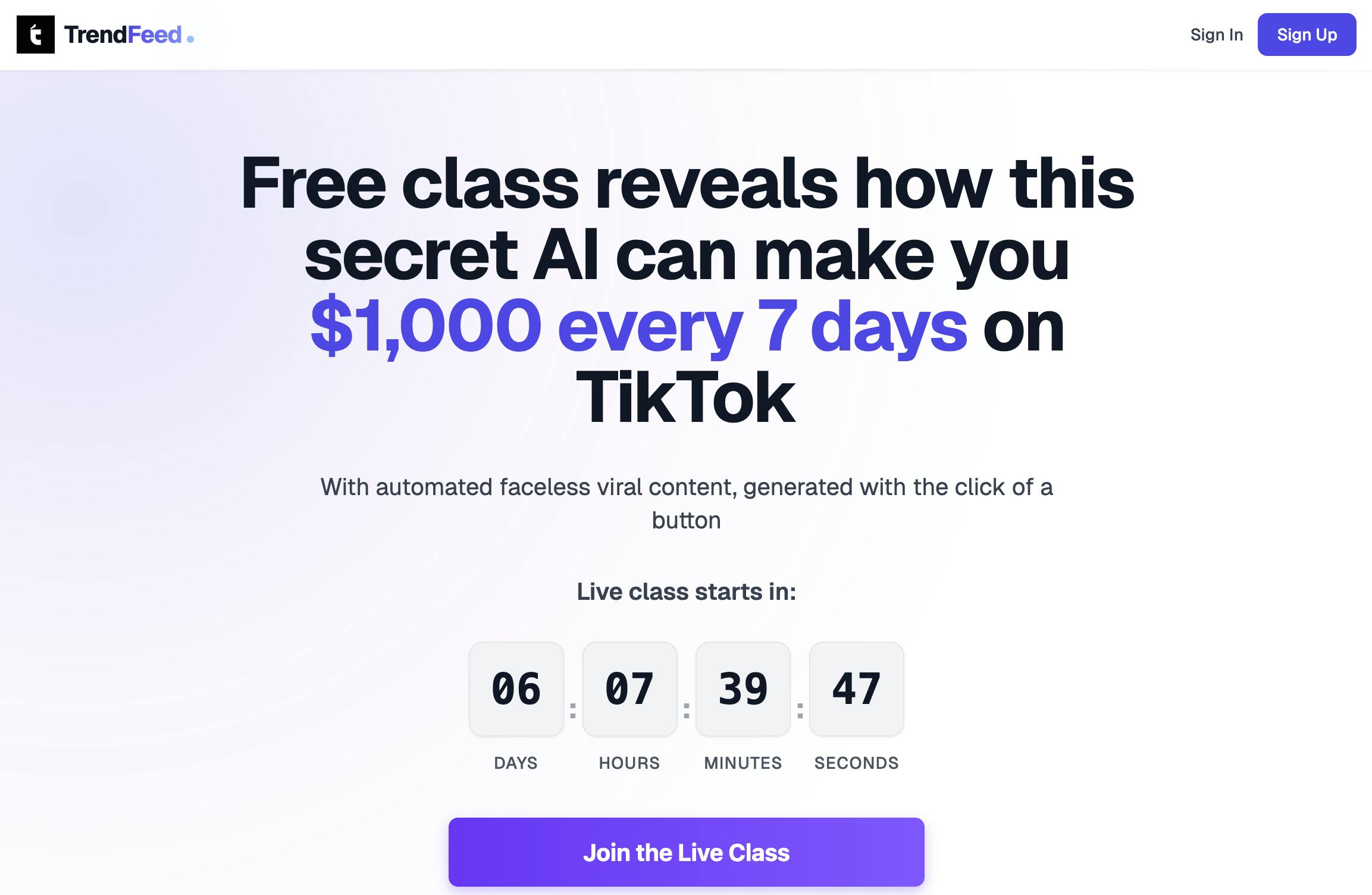
So we started building TrendFeed.app, a tool that aggregates viral news articles and automatically generates short-form video content from them.
For beginners, leveraging viral trending news is the most effective way to drive traffic. TrendFeed is designed for this: aggregating news articles, assessing their viral potential with an algorithm, and providing automated content creation tools. We knew that if we could let users make videos quickly and see results immediately, the tool would succeed.
I didn’t want TrendFeed to be just another generic AI video generation tool. There are hundreds of those, and most lack uniqueness. We focused on analyzing credible sources, using AI to identify viral trends, extracting visual material from those stories, and turning them into high-quality videos that Instagram and TikTok users actually want to watch.
We gave ourselves a week to launch. I used AI-generated code to build a minimum viable product (MVP) in just four days. Matthew directed traffic to the waitlist via his Instagram, email list, and newly created TrendFeed social accounts.
On February 27, we launched via a webinar, selling lifetime memberships, and made £5,500 on the first day.
Since then, we’ve been growing TrendFeed’s social presence to market independently (without relying on personal brand). I’ve upgraded the product extensively, added many features, and started offering annual subscriptions. Total revenue in the first four weeks reached £9,222 ($12,000).
More Than Another “Vibe Coding” App
I made sure this wasn’t just another “vibe coding” app that would break in production. Throughout the build, I focused on implementing security measures and guiding the AI model to ensure a well-structured product. Although I didn’t hand-write any of the code, I still had to understand clearly how to architect the application.
There’s still a lot of work to do, but early users have been patient and provided valuable feedback.
When I first built apps with Bubble, I could quickly understand SaaS and ship products, but they were slow, buggy, and I didn’t own the code.
TrendFeed was built entirely with AI coding, using Next.js, React (with ShadCN for UI), Supabase for database, and Vercel for deployment. The stack is evolving as we integrate Clerk for authentication and Whop for payments.
Since the code is fully AI-generated, I expect developers will try to hack this “vibe coding” app. That’s why I chose Clerk for its strong security, and spent 20%-40% of my time researching and implementing security measures — thanks to experience from previous projects.
Launching to an Audience
Our launch strategy was simple: sell through a webinar, which just required potential customers.
When I launched ChatIQ three years ago, I used TikTok short ads to showcase the product’s features, capitalizing on the ChatGPT hype with zero marketing costs and reaching £7,500 MRR. So I knew a new product launch needs an audience, and I spent the next two years building social influence.
I grew my Instagram, TikTok, and YouTube to 50k, 30k, and 4k followers respectively. These became the potential customer base for TrendFeed’s first launch.
Since we plan to sell TrendFeed in the future, every action we take aims to maximize the valuation multiple. That means not relying on my personal brand to promote it, so after the launch we shifted all marketing to new TrendFeed social accounts.
This caused a sharp drop in revenue — a new account with 100 followers obviously can’t compete with a 50k follower account. But as the account grows, so will revenue. The sales funnel is built; now we just need more traffic. We plan to expand through influencer partnerships, hiring content creators, and paid ads.
Many people think short-form video is the silver bullet for marketing, but unless the product is directly tied to trends (like my first SaaS, ChatIQ), you need to put in extra effort. It’s cliché, but consistent output really is the only guarantee of long-term growth.
Using a Webinar Funnel
Without a webinar funnel, our launch revenue wouldn’t have been possible. We’ve run dozens of webinars over the years, and we’ve nearly perfected the process — inspired initially by Russell Brunson’s Expert Secrets.
But webinars are hard. In the past 12 months alone, I’ve created 35 different versions of webinars for businesses outside TrendFeed, each with about 300 slides. For beginners, doing a weekly live demonstration of the app, collecting potential customers, and solving problems on the spot can also work.
Even a live demo with just 20 potential customers can dramatically boost conversion rates — handling objections in real time and building trust live.
To control the sales process through webinars, we’re currently in a closed beta. Users can’t just browse the website or try the tool — this unconventional strategy maximizes conversion, even though initially many doubted TrendFeed’s existence (thinking we were selling a course). In the future, we plan to offer a free plan with 5 trial credits.
Controlling the Sales Process
To illustrate the importance of sales control:
Our launch event sold 22 lifetime memberships at £249 each, generating £5,500 from just 250 leads and 400 website clicks. In contrast, a traditional SaaS funnel with the same 400 clicks might convert 5% to free users, then 10% of those to paid — resulting in just 2 paid users at £20/month, or £40 monthly revenue.
Summary:
- Controlled sales funnel: 400 clicks = £5,500 revenue
- Traditional SaaS funnel: 400 clicks = £40 monthly revenue
To match our launch revenue, the traditional funnel would need 52,000 website clicks
Getting traffic is hard in the early stages, so don’t send visitors to a passive landing page — you’ll lose sales control. While this setup works at scale, early on every lead matters. Even if someone doesn’t like the product, you can always refund.
Going a step further: The initial launch leveraged the trust built through my personal brand. But to validate this sales model with cold traffic, we’re now marketing entirely from faceless social accounts — building an audience while avoiding key-person risk.
The results show that conversion rates from new traffic match those from the launch period. These accounts didn’t exist four weeks ago; they grow fast by consistently putting out valuable content — provided you control the sales process. Imagine what happens when those clicks actually reach 52,000.
Selling a Solution, Not a Product
Finally, remember: content should sell the “solution,” not the “product.” Videos shouldn’t be SaaS ads — think about how many ads you scroll past.
The right approach:
- Show the pain point the product solves
- Add a controversial angle
- Hook the audience with a problem, then pitch a lead magnet
Example of what not to do: A video demonstrating app features
Example of what to do: A video showing the frustration the app solves → creates empathy → offers a lead magnet like a free course → funnels leads into a live sales event to close the deal
Focus on Distribution
A common mistake beginners make is launching a product into a vacuum and over-engineering it.
Your product doesn’t need to be perfect at launch. A great product won’t automatically go viral on X — behind every successful launch are thousands of failures the same day.
Focus on distribution: build a high-converting sales funnel. If your content isn’t getting more views, work on improving conversion rates.
Spend 70% of your time on marketing and sales. Building features for users who don’t exist is pointless.
Most importantly, be patient. TrendFeed’s first month revenue hit $9,000, but that came from a decade of accumulated learning. Don’t forget the effort behind the scenes.
Future Plans
We plan to grow TrendFeed into a product that steadily adds $20,000 per month in annualized recurring revenue (ARR). The initial goal was to exit within 90 days — becoming the first AI-built SaaS company to sell for a six-figure sum in three months. But if growth continues well, we might hold longer.
Looking ahead, I’ll keep building SaaS tools, but I’m particularly focused on the AI coding space. Though AI coding apps are controversial, I firmly believe that future app development will be fully democratized by AI.
I’ll continue sharing my journey of learning full-stack development and building products with AI. Soon I’ll also try automating workflows with agents.
Let me wrap up with a summary:
AI dramatically shortens the product development cycle, freeing up time that can be spent on marketing. By focusing content on “pain point solutions” rather than product features, he achieved a cold start. Here are the core takeaways:
- Distribution first: Spend 70% of time on marketing; early on, focus on conversion rate rather than polishing the product.
- AI coding trend: Use AI tools to improve development efficiency, but also ensure code quality and system stability.
- Rapid validation: Set a goal to build and sell a SaaS within 90 days; use Lifetime Deals to quickly recoup cash and validate commercial viability.