
From DeepSeek to Unitree’s Robot Dog: China’s Global Tech Breakthroughs
/ 8 min read /
Table of Contents 目录
Hi, I’m luckySnail. Today, let’s take a look at two major breakthroughs from China in AI and robotics — DeepSeek and Unitree Robotics. Recently, while browsing social media, I saw two products that even Silicon Valley bigwigs have praised and shared: one is DeepSeek’s V3 model, and the other is Unitree’s robot dog. The official Douyin video of that robot dog has already received over 800k likes. At last, we’re no longer just followers — we’ve made it to the table to play the game. We’re shifting from application innovation to core technology innovation, and more people are noticing. That’s why I believe these two products are immensely significant.
High-Flyer, which owns 10,000 NVIDIA A100 chips, released the latest DeepSeek V3 — it’s already surpassed the latest foreign models in many areas. Who doesn’t love an underdog story where a “poor kid from a humble family” gradually overtakes the “prestigious big family” of the West through innovation? Exaggerated as it may sound, it’s like a short drama script come to life — and the protagonist is a Chinese company. After talking about High-Flyer, let’s look at the Unitree robot dog that even Elon Musk liked. To date, Unitree Robotics has completed 9 rounds of funding, all from major institutions. Recently, related concept stocks have hit the daily limit. As we all know, where capital flows, there will be vitality. Unitree, which has secured so much funding, truly has real skills! Curiosity drove me to find out what kind of people and team developed such impressive products. Let’s explore together!
Achievements of DeepSeek and Unitree Robot Dog
Before we dive into the teams behind these two products, let’s first look at their “battle records.” Let’s start with DeepSeek.
DeepSeek

DeepSeek is a large language model independently developed by DeepSeek, an AI company under the well-known private equity giant High-Flyer Quantitative. Its latest V3 version has performance metrics comparable to top foreign AI giants, with the following advantages:
- Faster response speed — you can try it yourself at https://chat.deepseek.com/
- Cheaper pricing — its API cost is only 9% of Claude 3.5 Sonnet
- Lower training cost and shorter training time — its computational cost is only 1/11 of Llama 3 405B. OpenAI’s recent 12-day live stream also revealed that they’re facing high training costs.
- Most importantly, DeepSeek is open source. DeepSeek V3 was released and open-sourced simultaneously, going viral overseas. On top of its affordability, DeepSeek V3 is fully open source from day one, and they’ve published a 53-page paper laying out all training details.
- Various benchmarks show it’s on par with the current strongest models: OpenAI 4o and Claude-3.5-sonnet-1022.
People overseas call the V3 version a “black technology” or “mysterious power from the East,” but DeepSeek currently does not support multimodal output.
I’ve been using DeepSeek-V3 recently, and whether it’s coding or writing, it feels incredibly strong! Chinese output is likely even better than its foreign competitors.
Unitree Robot Dog
If you haven’t seen the video yet, check out Unitree’s official Douyin account. The pinned first video shows the robot dog doing 360-degree rotating jumps by quickly tapping the ground with four legs, two legs, or even one leg, and smoothly doing side flips to clear obstacles. It can nimbly traverse rugged forest terrain, and jump from heights of up to 2.8 meters without any damage, demonstrating exceptional stability. What’s more, it can sprint down steep, rubble-filled slopes, crawl over rocks in shallow water, and even carry an adult man “over mountains and ridges.”
The video is hugely popular both in China and abroad. Netizens say: “Scarily impressive!” “So advanced!” “This is what the future feels like!” Even Elon Musk, who works on robotics, liked the video and commented: “The future of war is drone warfare.” Currently, the robot dog costs $150,000 (about 1 million RMB). At first glance, I thought that was expensive, but the company is actually known as the “price killer,” holding 69.75% of the global market share for robot dogs.
High-Flyer and Unitree
In the fields of AI and robotics, High-Flyer’s DeepSeek and Unitree Robotics are two rising stars. DeepSeek is known for its innovative AI large model architecture (MLA: a new multi-head latent attention mechanism) and its open-source philosophy, with extremely low prices earning it the nickname “Pinduoduo of AI.” Unitree Robotics, with its high-performance, low-cost robot dogs and humanoid robots, has become a global leader in the quadruped robot market, often called “DJI of the robotics field.” Behind both companies are two technical idealists driven by persistence and exploration. Today, let’s see what sets them apart in the fiercely competitive tech landscape.
High-Flyer’s Liang Wenfeng
Liang Wenfeng was born in the 1980s in a fifth-tier city in Guangdong, where his father was a primary school teacher. He was fascinated by math and computer science from a young age, and studied software engineering at Zhejiang University, focusing on AI. After graduation, he entered the quantitative investment field and founded High-Flyer Quantitative, becoming one of the “Big Four” quantitative private equity firms in China.
In 2023, Liang founded DeepSeek, focusing on research into large AI models. Unlike many companies, DeepSeek chose a path that doesn’t chase quick profits, concentrating on cutting-edge technological innovation. They proposed the MLA (Multi-head Latent Attention) architecture and the DeepSeekMoESparse structure, which drastically reduced computation and memory usage, bringing inference costs down to just 1 yuan per million tokens. This triggered a price war among Chinese large models — and they were the source.
DeepSeek’s team mainly consists of fresh graduates from top domestic universities and young researchers. Liang, with a geek spirit, emphasizes that innovation requires curiosity and a desire to create, not just business-driven motives. They champion open-source culture, believing that closed-source moats are temporary and that the real value lies in team growth and experience accumulation.
Unitree’s Wang Xingxing
Wang Xingxing, founder, CEO, and CTO of Unitree Robotics, is a handsome post-90s guy from Ningbo. He’s been obsessed with technology since childhood. Although he was heavily lopsided in his studies — especially with poor English scores — he was passionate about math, physics, and hands-on building. In 2013, while pursuing his master’s degree at Shanghai University, he designed the first low-cost, high-performance quadruped robot, XDog, and won second prize in the Shanghai Robot Competition with it.
XDog’s success opened Wang’s eyes to the market potential of quadruped robots. In 2016, riding on XDog’s performance, he quickly received a job offer from DJI, attracting market attention. Soon after, Wang got a 2 million RMB angel investment from an individual and founded Unitree Robotics. From an initial team of 4 to over 400 people today, Unitree has gradually become the global leader in the quadruped robot market, with more than 60% of worldwide sales.
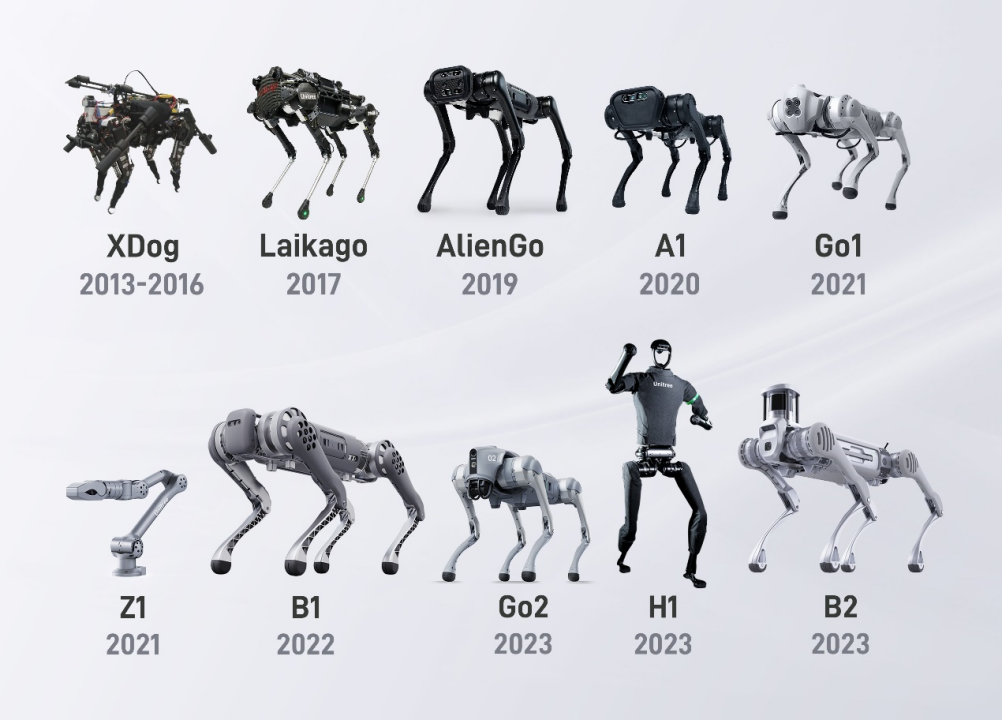
Unitree’s product line ranges from the consumer-grade robot dog Go1 to the industrial-grade B2, and then to humanoid robots H1 and G1, with continuous iteration and upgrades. They insist on self-developing core components, lowering costs while improving performance. For example, the Go1 sells for only 16,000 RMB, far cheaper than Boston Dynamics’ comparable products.
Unitree’s team is technology-centric, emphasizing self-development and innovation. Wang believes that only by mastering core technology can a company remain invincible in competition. Their products are widely used not only in universities and research institutions, but also in industrial scenarios like power grid inspection and fire rescue.
Insights
- Innovation-driven and technical idealism: Both chose an innovation-driven path rather than rapid commercialization. Liang and Wang both emphasize that technology should serve the public, not just business interests.
- Local talent and team culture: They focus on cultivating local talent. DeepSeek’s team is mainly composed of graduates from top domestic universities, and Unitree’s core tech team also relies heavily on local talent. They both advocate a geek spirit, encouraging team members to grow through innovation.
- China has the soil for Silicon Valley too: Their stories show more people that Chinese companies can not only achieve breakthroughs in application innovation but also secure a place in cutting-edge technology. Their success plants a culture in China.
Opportunities for Ordinary People in the AI Era
In the stories of DeepSeek and Unitree, we see the light of technical idealism and how innovation can change the world. But AI and robotics are not just stages for tech giants — they are quietly opening a new door for ordinary people. We can clearly feel that AI is no longer an unattainable black technology; it’s integrating into our daily lives. They all tell us: AI is a tool, and the point of a tool is how you use it. For ordinary people, AI is an assistant that boosts efficiency, a key to unlocking new skills, and a lever to create value. We can see that various AI platforms are encouraging ordinary people to get involved in AI creation. In the AI era, everyone has the chance to be a creator. We can quickly generate text, design images, write code, and even develop our own apps with AI, turning ideas into reality.
However, with the arrival of AI, 2024 has seen a wave of layoffs both in China and abroad. In this era full of uncertainty and crisis, only by embracing change — first hopping on the AI express and then finding your place — can you avoid being left behind. Every generation has its own difficulties and opportunities. The future belongs to the positive and courageous. Let’s adapt to the AI era together and become participants in this transformation!
This is probably the last post of 2024. Let’s cheer for 2025 together!
References
- Wall Street News Interview with High-Flyer’s Liang Wenfeng: https://wallstreetcn.com/articles/3719982
- How Unitree Robotics Became a Global Leader in Quadruped Robots in Eight Years: https://finance.sina.com.cn/wm/2024-08-11/doc-incihnfv8395863.shtml
- DeepSeek-V3 Training Cost: https://hub.baai.ac.cn/view/42248